



Afnic and Fréquence Écoles, with the support of the CNIL[1], have been partnering since 2025 to roll out REZO, a national educational resource on the theme of digital identity and autonomy for 15- to 18-year-olds.
The goal: to raise awareness among 20,000 young people over 4 years.
We spoke to Camille Huré, Marketing Manager at Afnic, and Dorie Bruyas, Managing Director of Fréquence Écoles, to find out more about the programme’s scope.
Tell us a bit about Fréquence Écoles!
Dorie: Fréquence Écoles is a public-interest association that has been working to promote the digital emancipation of children, teenagers and their parents for 20 years now.
It has three main focuses:
- Designing educational projects and resources on digital uses, safety and citizenship;
- Conducting field research and studies, notably on online training for the Pix digital skills platform and regional policies for digital education;
- Supporting and training professionals and regional authorities in their digital education policies.
In 2025, the association supported 8,600 children, teenagers and adults, trained 560 professionals in providing digital support, and raised awareness among 650 other professionals about the challenges of digital education.
Fréquence Écoles works in particular alongside the CNIL, the French Ministries of Culture and National Education, the National Agency for Territorial Cohesion (ANCT), the French Agency for Ecological Transition (ADEME), and the French Regulatory Authority for Audiovisual and Digital Communication (Arcom).
Why this partnership?
Camille: Raising awareness of the issues and best practices surrounding digital technology is at the core of Afnic’s missions. It provides a means to approach these subjects with young people while making them aware of the impact of their actions online. It also helps pass on to them the knowledge and skills they need to develop good habits.
We organise over one hundred educational and participative workshops in schools, from secondary level to higher education, every year to support young people in their digital education. These actions are implemented with our partners: the French Federation of Student Councils (FFBDE), the JobIRL (Job In Real Life) platform, Fréquence Écoles and the Pépite France Student-Entrepreneurs network. We also contribute to the Pix digital skills assessment and certification framework, incorporating questions relating to domain names, websites and digital sovereignty.
Our partnership with Fréquence Écoles is part of this initiative. With 20 years of experience working with young people and the education community, the association shares our determination to make digital education accessible, concrete and tailored to the way young people use digital technology.
Our 4-year partnership (2025-2028) aims to make digital education a tangible and reusable national intervention programme, REZO. It aims to boost adolescents’ autonomy and their capacity to navigate safely online.
REZO Logo
The challenge is to combine content closely aligned with young people’s practices and concerns, solid support for professionals and broad dissemination in order to instil a safer and more autonomous digital culture.
Dorie: Because Afnic holds a piece of the puzzle that almost nobody explains to young people: the inner workings of the Internet. Adolescents are used to hearing about social networks, personal data and screen time. But we don’t spend much time talking about what’s under the hood: what a domain name actually is, who manages the .fr TLD, how an address becomes a website, why a URL can be misleading. And yet this foundation is precisely what enables them to spot phishing, assess the credibility of a website or understand what digital sovereignty really means. Afnic brings this first-hand expertise, which we drew on to design the REZO scenarios that cover these topics: domain names, network infrastructure, website reliability, phishing.
The second contribution lies in the very nature of Afnic. Afnic is a public interest organisation, with no commercial interest in young people’s digital uses. For an association building an open-licensed educational commons, Afnic is a natural partner: we can explain the Internet to pupils and students without selling them a platform or app.
Lastly, Afnic has opted for a rare arrangement in our sector: a four-year commitment. Funding for digital education is more often than not allocated on an annual basis and earmarked for a specific project. Four years is what it takes to develop a commons with young people and teachers, test it in class, apply any corrections, and implement a wide-scale roll-out. And the partnership is not limited to funding: the workshops Afnic runs each year and its networks, from student groups to Pix, are all channels that can help publicise REZO.
What makes the programme with Fréquence Écoles different?
Dorie: Fréquence Écoles uses an instructional design approach that draws directly on the problem situations young people encounter.
Resources are developed through discussions with young people based on problem scenarios aligned with their uses and concerns.
So the REZO programme is the result of co-construction with young people and the professionals who support them. This co-construction helps strengthen the commitment of these young people when it comes to getting to grips with the resources available to them.
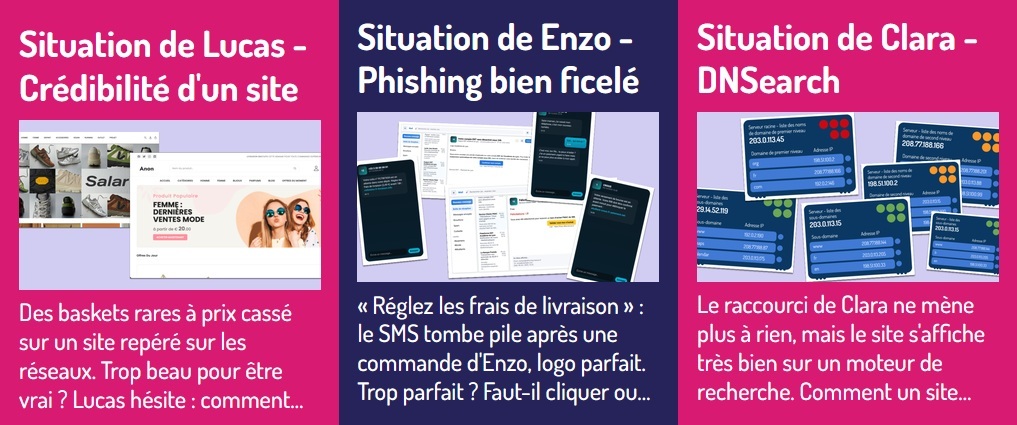
The visual depicts 3 scenarios (out of the 12 currently available) offered to students as part of the REZO program:
Lucas’s scenario – Website credibility
Rare sneakers at a bargain price on a site discovered via social media. Too good to be true? Lucas hesitates: how can he tell if the site is reliable before…
Enzo’s scenario – A well-crafted phishing attempt
“Pay the delivery fees”: an SMS arrives just after Enzo has placed an order—the logo looks perfect. Too perfect? Should he click, or…
Clara’s scenario – DNSearch
Clara’s shortcut no longer leads anywhere, yet the site appears perfectly fine in a search engine. How can a site be simultaneously impossible to find…
Another key feature of Fréquence Écoles is the support it provides to teachers in the form of a toolkit (materials to display during the session, printable activity kits, a getting-started guide for the resource; all under a Creative Commons CC BY-SA licence).
Consistent with school curricula and France’s national Digital Skills Reference Framework (CRCN), the resources are produced for use in Moral and Civic Education (EMC) classes and in Technology classes at lower secondary level (collège), and Digital Sciences and Technology (SNT) classes at upper secondary level (lycée).
The activity pathways have been designed with a granularity that allows the educational content to be split without compromising its quality, while offering flexibility of use.
Lastly, thanks to its 20 years of experience, Fréquence Écoles is very familiar with the players in digital mediation and education in the regions (media libraries, youth centres, etc.). They are also recognised by the heads of national institutional networks, which allows for large-scale roll-out of resources (education directorates in France’s departments and regions, the regional digital education departments of the education authorities (DRANEs), regional digital inclusion hubs, and the national cooperative of digital inclusion and digital mediation actors La Mednum).
Alongside Afnic, we have built a free, open-source resource, designed with young people and teachers, and made to last.
What are the next steps?
Camille: The first two years of our partnership have made it possible to design 12 scenario modules, raise awareness among 4,000 young people and train 50 teachers.
Several of these 12 scenarios cover topics central to our mission: how domain names work, Internet infrastructure, website credibility and phishing. Students take a real-life digital case and solve it as a group.
Dorie: The next two years will focus on rolling out REZO initiatives and the gradual onboarding of a community of upper secondary teachers at national level in order to reach an additional 16,000 young people and almost 100 professionals.
This roll-out will be carried out by teachers via regional education authorities and via La Forge des communs numériques éducatifs (LaForgeÉdu), a community of teachers who create and share free and open-source software and open educational resources.
[1] Commission Nationale de l’Informatique et des Libertés, France’s independent data protection authority: https://www.cnil.fr/en
On the same topic
Featured
News
11/17/26
ANSSI and Afnic publish the 2026 Internet Resilience Observatory ...
The French National Cybersecurity Agency (ANSSI) and Afnic, ...
Expert papers
REZO: concrete answers to young people
Afnic and Fréquence Écoles, with the support of the CNIL[1], ...
Agenda
12/14/2026