



On 10 September 2026[1], Afnic announced that it had been awarded the “Engagé RSE” CSR label at “Exemplary” level by AFNOR Certification, the highest level of the “Engagé RSE” reference framework.
This new milestone recognises and confirms the achievements made through Afnic’s transversal CSR initiatives.
We took a closer look at the mechanisms put in place by Afnic and the efforts it has made to bring about these changes.
Interview with Virginie Navailles, Head of Transversal CSR Approaches at Afnic.
Virginie Navailles, what’s behind this progress?
VN: During the initial assessment performed in 2023 by AFNOR Certification as part of the “Engagé RSE” process, Afnic was awarded “Confirmed” level. This already proved that Afnic was factoring CSR issues into its strategy and activities, and that the CSR management system set up in 2022 was well adapted. This initial assessment enabled us to draw up a 3-year progress plan, broken down into one-year action plans. The 3-year plan was approved by our Board of Trustees, which set an ambitious target of 60% achievement by 2024 – to kick-start roll-out across all our business lines – and 80% by 2025.
The follow-up audit in December 2024 affirmed that we were on the right track. We have now achieved our objectives. The step up to “Exemplary” level this year acknowledges the work accomplished by all our teams in the last three years, which includes:
- Setting up a CSR management system based on the ISO 26000 standard to oversee and continuously improve our practices regarding the seven pillars of CSR: organisational governance, human rights, labour practices, the environment, fair operating practices, consumer issues, and community involvement and development.
- The climate change risk assessment (under the CSRD framework[2]), which is informing our discussions on climate change adaptation and enabling us to address these risks holistically, in conjunction with our ISO 27001 certification.
- Training for all teams on the CSR issues affecting their business lines and how to embed them in our processes: eco-design, responsible purchasing, regulatory watch, responsible marketing and communication, etc.
- Introduction of forward-looking jobs and skills management (GPEC).
- Strengthening our environmental policy. Afnic has drawn up its carbon assessment and implemented greenhouse gas emissions reduction plans since 2012, and contributed to global carbon neutrality since 2022. We have expanded our actions by supporting biodiversity conservation and rehabilitation programmes since 2023.
- An audit of our Information Systems Department’s practices and definition of a roadmap for rolling out eco-design approaches based on the RGESN (General Reference Framework for the Ecological Design of Digital Services).
- A new CSR report format based on the standard for voluntary use (within the CSRD framework) to make our practices and results comparable at European level and provide information required by customers and principals.
- An assessment of the impact of Afnic’s information system on planetary boundaries, to confirm our dependencies (risks) and provide a basis for discussing our supply chain against the backdrop of adapting to climate change.
What other priorities had Afnic set for itself?
Combating corruption
Afnic finalised the update to its whistleblowing system in 2025. This system is available internally and externally, for everyone, whether victim or witness, to report conduct they believe is unethical, illegal or likely to represent a significant danger to the Association, its employees or customers, public health or the environment.
In order to ensure the integrity of the system and in accordance with Article L. 1132-3-3 of the French Labour Code, to provide effective protection to employees wishing to report culpable conduct, this procedure is covered by a number of key principles. These principles are aimed at ensuring fair and impartial handling of the reports, while at the same time protecting the whistleblower and the party or parties concerned.
Risk management
After setting up our CSR management system based on the ISO 26000 standard, Afnic carried out a simple materiality analysis in 2022 which identified the main social, environmental and governance impacts.
In 2024, using the framework provided by the CSRD, Afnic then performed a double materiality analysis, enabling climate change-related issues, impacts, risks and opportunities to be added to the existing risk maps.
This assessment was consolidated in early 2025 by cross-referencing it with the materiality ratings for the digital sector identified in the online tool ENCORE[3].
Afnic then assessed the impact of the information system at the heart of its activity on the nine planetary boundaries. This confirmed the impacts, dependencies and risks for our value chain by measuring impacts beyond carbon emissions alone, providing a more accurate picture along with some quantified data to help us discuss the climate change adaptation plan.
This work also contributed to the application of Amendment 1: “Climate action changes” to ISO/IEC 27001:2022, published in 2024, in the context of the certification process. Actions to address the risks, limit dependencies and reduce impacts are included each year in the action plans.
The following main issues have been identified
| Issue as defined by ISO 26000 | Correspondence with the CSRD |
| Sustainable resource use | ESRS E5 – Resource use and circular economy |
| Protecting consumers’ health and safety | ESRS S4 – Information-related impacts for consumers and/or end users |
| Consumer data protection and privacy
|
ESRS S4 – Information-related impacts for consumers and/or end users |
| Access to essential services | ESRS S4 – Social inclusion of consumers and/or end users |
| Conditions of work and social protection and Social dialogue | ESRS S1 – Working conditions |
| Health & safety at work | ESRS S1 – Working conditions |
| Stakeholder identification and engagement | ESRS G1 – Business conduct |
| Prevention of pollution | ESRS E2 – Pollution |
| Skills development | ESRS S1 – Equal treatment and opportunities for all |
| Climate change mitigation and adaptation | ESRS E1 – Climate change adaptation |
| Social investment | ESRS G1 – Corporate culture |
| Consumer service, support, and complaint and dispute resolution | ESRS S4 – Personal safety of consumers and/or end users |
| Promoting social responsibility in the value chain | ESRS G1 – Business conduct |
| Discrimination & vulnerable groups | ESRS S1 – Equal treatment and opportunities for all |
| Anti-corruption | ESRS G1 – Business conduct |
Can you tell us more about the costs associated with CSR for Afnic?
When it comes to CSR, we prefer to talk about investments rather than costs.
In addition to the 11% of turnover we re-invest each year in general interest actions, CSR expenses consist mainly of:
- our contribution to global carbon neutrality,
- support for biodiversity protection and rehabilitation projects,
- training for our teams,
- adaptation of our premises, and support for sustainable mobility under a company agreement signed in 2024.
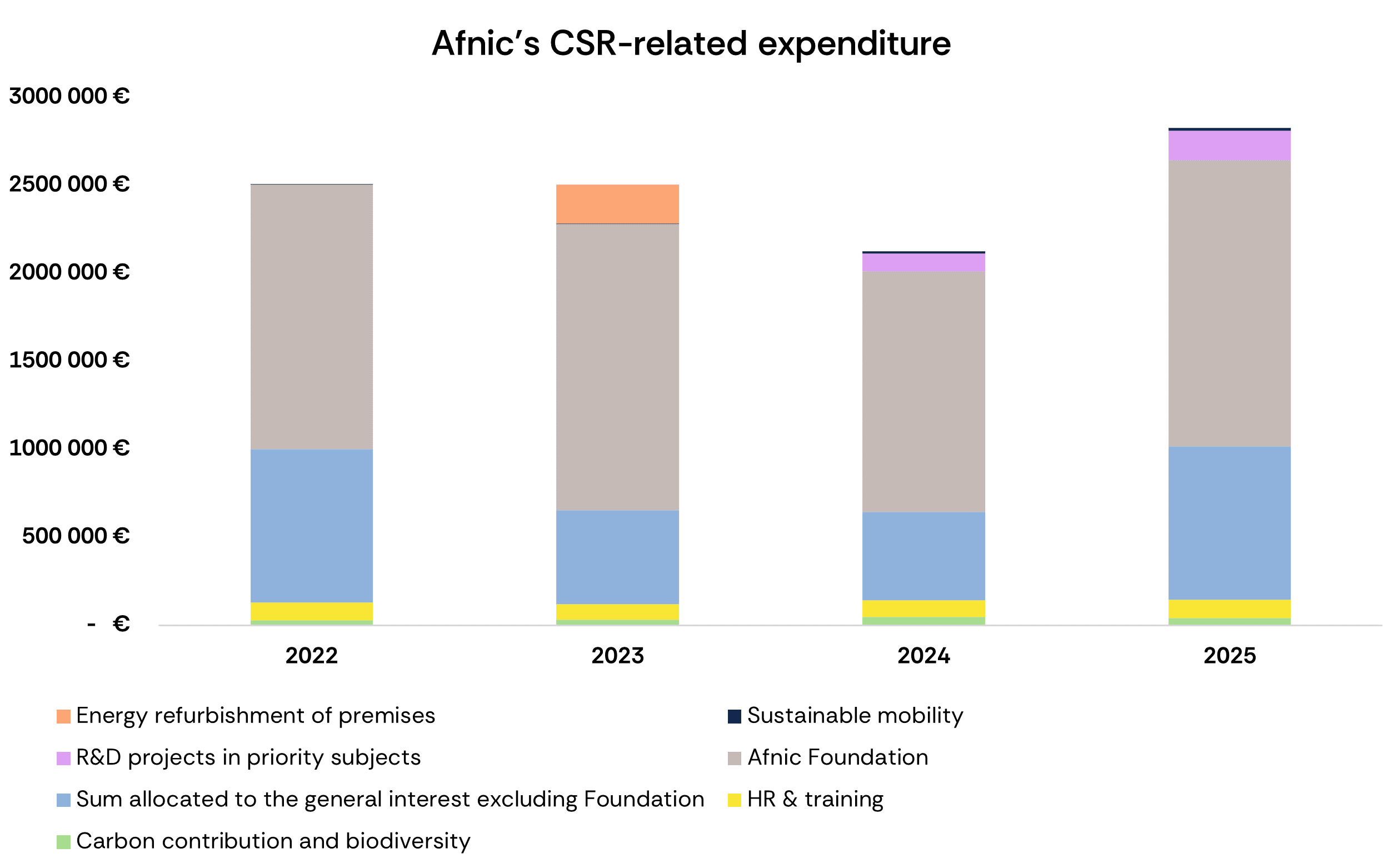
Data for the figure “Annual CSR expenditure”
| 2022 | 2023 | 2024 | 2025 | |
| Carbon contribution and biodiversity | €28,455 | €32,000 | €47,000 | €42,000 |
| HR & training | €101,269 | €88,092 | €93,734 | €104,035 |
| Sum allocated to the general interest excluding Foundation | €871,088 | €534,393 | €502,982 | €870,152 |
| Afnic Foundation | €1,504,000 | €1,627,000 | €1,368,250 | €1,626,255 |
| R&D projects in priority subjects | €101,434 | €168,265 | ||
| Sustainable mobility | €254 | €549 | €12,014 | €15,648 |
| Energy refurbishment of premises | € – | €223,000 | € – | € – |
| Total sum allocated to the general interest | €2,375,088 | €2,161,393 | €2,302,982 | €2,496,407 |
What are the next steps?
Our new strategy strengthens our CSR commitments to promote a responsible, sustainable and inclusive Internet built on efficiency, safety and sufficiency. For the first time, we are adding a new strand: affirming Afnic’s role as a “centre of excellence and expertise” and building our teams’ skills and the Association’s technical and organisational capabilities.
These ambitions, centred on sovereignty and digital transition, skills management, reducing our environmental impact, adapting to climate change and increasing our support for biodiversity protection, are to be enshrined in a new progress plan for 2027 to 2029.
[1] Afnic awarded the Engagé RSE CSR label at Exemplary level, AFNOR Certification’s highest level
[2] CSRD: The Corporate Sustainability Reporting Directive (CSRD) is an EU directive adopted in 2022 that requires companies to report more detailed information on environmental, social and governance issues.
On the same topic
Featured
News
10/12/26
Innovation: publication of DashMARC, a free solution to analyse ...
Developed by Breizh Cyber with the support of Afnic and the www.bzh ...
Expert papers
CSR issues: 2023-2025 objectives achieved
On 10 September 2026[1], Afnic announced that it had been ...
Agenda
10/26/2026